
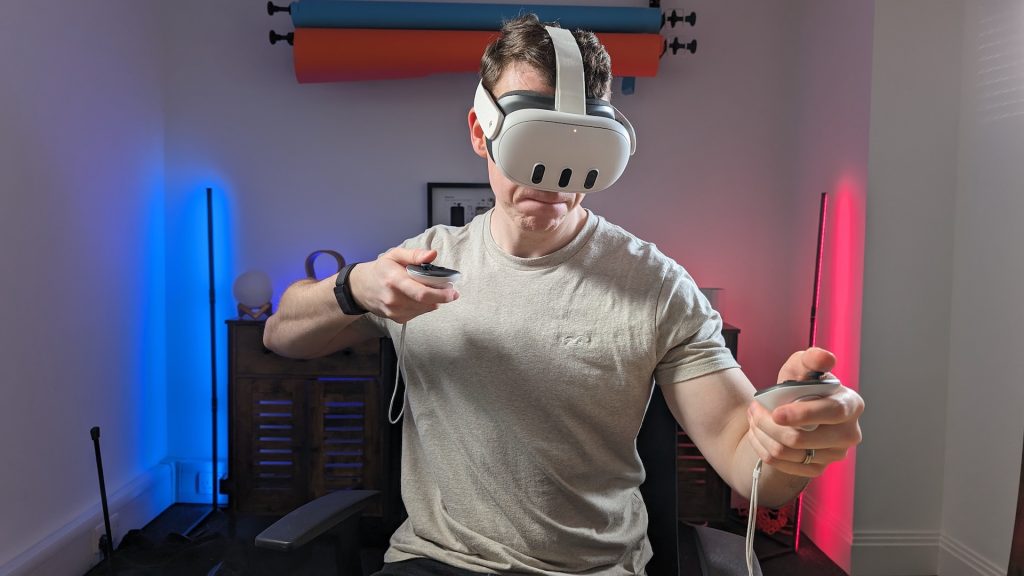
Meta might be cutting staff, but it’s not backing away from VR just yet.
Despite ongoing layoffs at Reality Labs and continued questions over the future of the metaverse, the company has used its latest earnings call to quietly reaffirm that new VR hardware is still in the works.
CEO Mark Zuckerberg largely steered clear of VR during the call. Instead, he highlighted the growing success of Meta’s smart glasses, which he said have seen sales more than triple year-on-year.
At first glance, that shift in focus didn’t sound great for VR’s prospects. However, when pressed by investors, Meta’s CFO Susan Li offered a clearer signal of intent.
“We continue to have optimism in the future of VR,” Li said, confirming that Meta is still investing in “building future headsets”. However, that optimism came with a caveat. Consumer adoption of VR has grown more slowly than wearables. As a result, Meta is now rebalancing its Reality Labs portfolio to reflect that reality.
No specific products were named. However, recent leaks suggest Meta has at least two headsets in development for 2026 or 2027. One is expected to be a more conventional Quest 4, likely following the Quest 3 formula with both higher-end and more affordable variants.
The other, often referred to as a Quest Pro 2, could be a more radical redesign. It may be an ultra-light headset closer to glasses or goggles. Additionally, its battery and processing might be offloaded to a pocket-sized puck. Notably, that model is said to focus more on productivity than gaming.
Alongside hardware, Meta is also hinting at a bigger role for AI in VR’s future. Zuckerberg teased a concept that sounds straight out of science fiction. He mentioned the ability to tap on any video and instantly “jump into it” as an immersive experience. While that’s clearly not around the corner, it builds on Meta’s existing AI tools. These tools can already convert 2D scenes into stereoscopic 3D.
Those ideas may extend beyond VR headsets, too. Zuckerberg’s comments suggest similar tech could eventually feed into Meta’s mobile and Horizon platforms. This could allow users to generate immersive spaces from photos or videos. Clearly, this is a potentially powerful hook as Meta looks to differentiate its AI efforts from rivals like ChatGPT and Gemini.
There’s still no clear timeline, and plenty of uncertainty remains. However, despite the layoffs and slower-than-hoped VR adoption, Meta is clearly not ready to give up on virtual reality just yet.
The post Despite layoffs, Meta’s doubling down on VR with future headset tease appeared first on Trusted Reviews.