

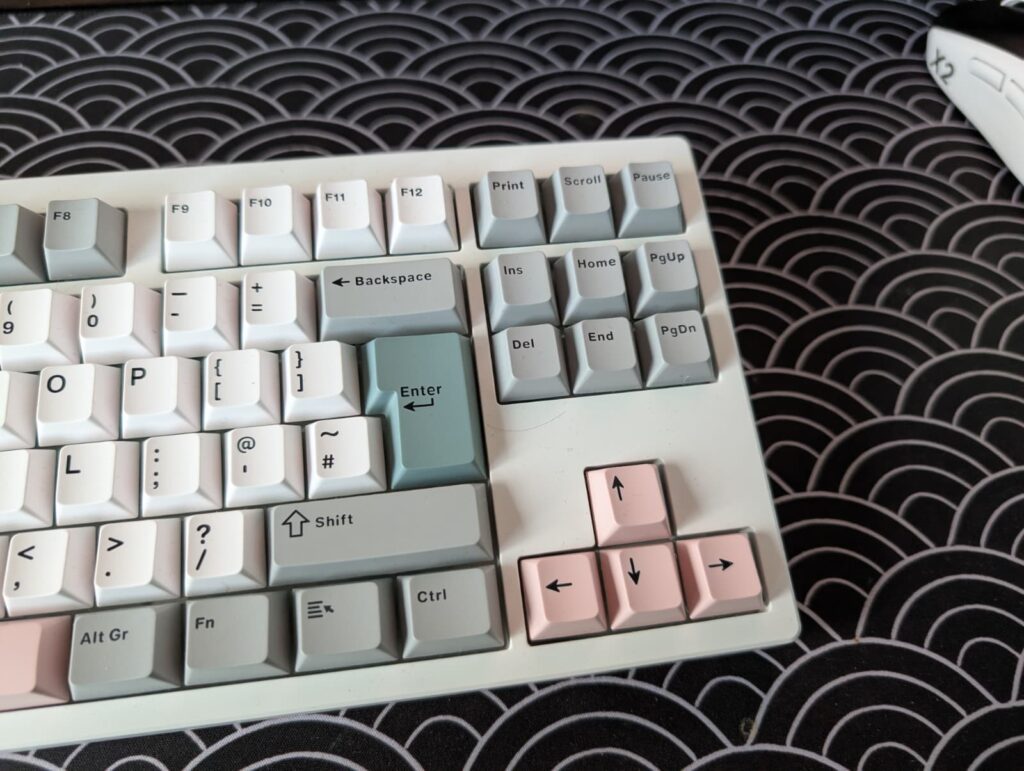
It’s been a while since I’ve sat here and talked about a product and made a video, not sure if I remember how to do this. Well, today I’m going to be talking about the EPOMAKER TH87, and this is an interesting one because it packs quite a lot of features into a fairly traditional ten-keyless keyboard design. I’ve been using it now for a few days, and feel like I can at least give a first impression opinion. And spoiler, I really like it. Now, if you’re not familiar with the TKL layout, essentially you’re getting 87 keys, but without the number pad. So you still get the function keys, arrow keys and everything else you would expect from a more traditional keyboard, but you’re saving a bit of space on your desk. Well, a few inches from not having a number pad but still that’s something.
And personally, I think TKL keyboards are a really nice middle ground. They’re not too small, but they’re also not taking up as much space as a full-sized keyboard. The version we’re looking at here is the ISO-UK layout, which is always nice to see, especially for those of us here in the UK. One of the first things that stands out about the TH87 is that this is a tri-mode keyboard. So you’ve got Bluetooth, 2.4GHz wireless and a wired USB connection. That gives you quite a lot of flexibility depending on how you’re planning on using it. I use mine using the 2.4GHz dongle straight into the front of my PC, and it works like a charm and battery life is really good too thanks to the 10,000mAh size. It’s also compatible with Windows, Mac and Android, so if you regularly switch between devices, this could be quite useful. EPOMAKER says you can expect around 45 hours of use with the RGB lighting at maximum brightness, or up to around 200 hours with the backlighting switched off. So, depending on how much you use the RGB lighting, you could potentially go quite a while without needing to charge this thing.
Now, when it comes to the actual typing experience, EPOMAKER has included quite a few features that you’d normally associate with more enthusiast-focused mechanical keyboards like the gasket-mounted design, along with a flex-cut PC plate and PCB. The idea behind that is to give the keyboard a slightly softer and more cushioned typing feel, rather than everything feeling completely rigid. EPOMAKER has also put quite a lot of effort into the sound dampening. And I must say this thing sounds super thocky.
There are actually five different layers inside the keyboard designed to help improve the overall sound. You’ve got PORON sandwich foam, an IXPE switch pad, a sound enhancement pad, an EPDM switch socket pad and a silicone layer at the bottom. The switches are also pre-lubed from the factory, which is always good to see. And importantly, this keyboard is hot-swappable, so if you decide later on that you want a completely different typing experience, you can swap out the switches without needing to solder anything. I’ve got the creamy jade switches in mine and the typing experience is second to none. The thockyness of this keyboard is lovely. The TH87 also uses Cherry profile PBT keycaps with double-shot legends and they feel durable enough, but only time and extended use will tell with how long the keys will last.
Of course, we’ve also got RGB lighting. The TH87 has per-key adjustable, south-facing RGB LEDs, with both dynamic and static lighting effects. I’ve generally kept it on its RGB setting, though there are loads to choose from, and if you like subtle lighting, then you can certainly choose that option too. The keyboard also has a 1000Hz polling rate when using either wired or 2.4GHz wireless, while Bluetooth runs at 125Hz. And of course, you’ve also got N-key rollover and anti-ghosting.
So whether you’re gaming, typing or accidentally pressing about five keys at once because something’s gone horribly wrong, the keyboard should be able to handle it. In terms of comfort, you’ve got a two-stage kickstand on the back, giving you three different typing angles: 6 degrees, 8 degrees and 10.5 degrees. So you’ve got a bit of flexibility there depending on how you like your keyboard positioned on your desk. The keyboard itself weighs around one kilogram, so it’s got a decent amount of weight to it. It’s not something that’s going to be sliding all over your desk every time you’re typing, but it’s still compact enough thanks to that tenkeyless design.
Overall, the EPOMAKER TH87 seems to be trying to offer quite a lot in one package. You’ve got the TKL layout, tri-mode connectivity, a massive 10,000mAh battery, hot-swappable switches, gasket mounting, five layers of sound dampening, PBT double-shot keycaps and per-key RGB lighting. And I think that’s what makes this keyboard interesting. It gives you quite a lot of the features that people look for in enthusiast mechanical keyboards, but in a ready-to-go package.
So if you’re looking for a tenkeyless keyboard and want something that offers plenty of customisation, wireless connectivity and a focus on both sound and typing feel, the EPOMAKER TH87 could definitely be worth considering. But as always, let me know what you think. Would you go for a TKL keyboard like this, or do you prefer a full-sized keyboard with a number pad? Let me know down in the comments, and if you’ve enjoyed this video, don’t forget to leave a like, subscribe if you haven’t already, and I’ll see you in the next one.
The post EPOMAKER TH87 ISO Mechanical Keyboard Review appeared first on TechNuovo | Bitesized tech news and reviews.