

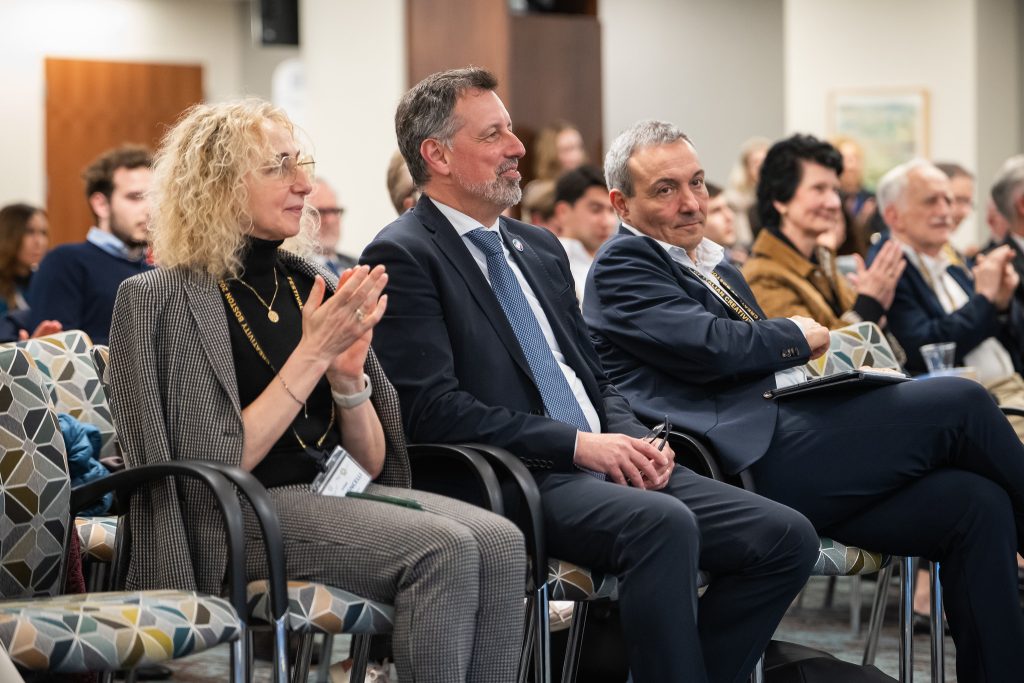
Seven Italian-American startups, within the context of the 2026 Made in Italy Day, presented themselves to investors in the first panel of the final day of STB Days, with the goal of redefining global innovation while strengthening the Italy–America bridge.
April 15 is not just any date—it marks the birthday of Leonardo da Vinci, and it is no coincidence that the Italian government chose it to establish Made in Italy Day, officially celebrated since 2023 to protect, promote, and project worldwide the excellence of Italian creativity, industry, and culture. After marking April 15 with a series of expert panels focused on key research topics, Boston took the stage again the following day. On April 16, during the third and final event of the STB Days—Science, Technology and Business Days—the Italian Consulate General organized Innovation Day, conceived within the framework of Made in Italy Day: a marathon of ideas, startups, investors, and visions focused on the future of the transatlantic relationship between Italy and the United States.
STB Days is an original format launched three years ago by the Consulate General and now represents a best practice in promoting bilateral scientific cooperation. Its ambition is straightforward: not just to talk about innovation, but to enable it. For three days, it brings together an exceptional community of innovators, entrepreneurs, researchers, investors, and institutional partners from both sides of the Atlantic in Boston—a global hub for research and technology, home to a highly influential Italian academic, scientific, and entrepreneurial community.
The first panel of the day—the core of Innovation Day—was organized in collaboration with 42N, a network of entrepreneurs, managers, and professors who volunteer their time to foster connections between the two ecosystems. It was opened by Arnaldo Minuti, Consul General of Italy in Boston, and Paolo Gaudenzi, Science and Technology Advisor at the Consulate and Full Professor (on leave) of Aerospace Structures at Sapienza University of Rome.
Gaudenzi is a figure worth introducing. An aerospace engineer who graduated cum laude from Sapienza in 1984, he is among the most cited Italian researchers in the field of smart structures and space systems, ranking in Stanford University’s top 2% of scientists worldwide. He has over 4,400 academic citations and collaborations with ESA, NASA, Thales Alenia Space, and AVIO, along with research projects for the Italian Space Agency and the European Union. He has delivered invited lectures at Columbia University, TU Delft, and ETH Zurich, and served as a liaison between Sapienza and the U.S. Embassy in Rome for space-related disciplines.
“Innovation does not happen in isolation. It happens through people—when ideas circulate and different perspectives meet. Today is one of those moments.”
— Arnaldo Minuti, Consul General of Italy in Boston
The panel, moderated by Roberto Dolci, founder of 42N, opened with a striking figure: 68%. That is the failure rate of new products in the fashion and footwear sectors. In footwear alone, this translates into $300 billion in lost revenue annually. The issue is not quality or design, but process: product briefs are still built on outdated data, gut instincts, and disconnected spreadsheets across sales, marketing, and design teams.
Addressing one of the most costly challenges of Made in Italy is Ada IQ, a startup offering a solution through an artificial intelligence engine called Smart Brief. It integrates real-time consumer search signals, competitive intelligence, and design reasoning into a single platform, enabling teams to evaluate and refine products before they reach the market. Led by Professor Paolo Ciuccarelli of Northeastern University, the team brings together 80 years of combined experience in consumer product development and enterprise software, with roots in Salesforce Commerce Cloud.
In cybersecurity, ai.Esra—an Italian startup with 25 technical professionals—challenges traditional paradigms. Instead of relying on company declarations, it creates a real-time updated digital twin capable of identifying hidden vulnerabilities. The result: assessment times reduced by 70%.
Most cyber risk evaluations are based on interviews with company managers, who often lack full awareness of their own networks. There are devices, processes, and vulnerabilities—“ghost observers”—that remain unknown. ai.Esra’s solution builds a real-time digital twin of the organization without requiring installation on individual devices. Documented results include a 70% reduction in assessment time and savings of $100,000 on first use for a client with 11,000 devices. The cyber risk scoring market is expected to reach nearly $4 billion by 2025, with annual growth of 20%.
The most conceptually dense contribution came via video from Washington, D.C. Giacinto Paolo Saggese—PhD in Electrical and Computer Engineering from the University of Illinois, former Nvidia and Google engineer, and machine learning professor at the University of Maryland—is now on his third startup. His company, Causify, focuses on causal AI, a branch of artificial intelligence that remains niche despite its importance. Unlike traditional AI, which identifies correlations, causal AI understands cause, effect, and time.
The distinction is clear: traditional AI recognizes that smoke and fire are related, but does not determine which causes the other. For systems making real-world decisions—financial markets, supply chains, energy management—this limitation is critical.
“When you need money, no one wants to give it to you. When you don’t need it, everyone wants to invest. You have to do the opposite of what you think.”
— Giacinto Paolo Saggese, CEO of Causify
In the energy sector, Lightsmith addresses structural limitations of traditional power grids facing rising demand and costs. Its solution is a Virtual Power Plant (VPP) platform that aggregates thousands of distributed energy assets—solar panels, batteries, electric vehicles—and orchestrates them as a single power source equivalent to a conventional plant. The paradox it resolves is that these assets already exist but are used at only 20–30% of their capacity.
Osense applies causal reasoning to business decisions, enabling CFOs to simulate the real impact of choices on EBITDA, ESG metrics, and supply chains within hours rather than months. Instead of static reports, the platform allows companies to input specific decisions—such as changing suppliers or adjusting logistics—and projects their financial consequences over 18 months, with full traceability.
SunSpeaker tackles a more tangible issue: aesthetics. CEO Fabrizio Giannini presented a technology called C-B Ion, which wraps solar panels in a customizable film, making them nearly invisible while maintaining 85% energy transmission. This is particularly relevant in historic areas, protected landscapes, and aerospace or military applications where visual impact can block installations.
The final presentation came from Marco Eugeni, CEO of Smart Structures Solutions. The company develops digital nervous systems for critical infrastructure—telecom towers, energy plants, broadcasting stations, factories—through sensors and intelligent algorithms that monitor structural integrity, prevent failures, and enable condition-based maintenance.
Beyond the numbers and pitches, a broader insight emerged. As Saggese noted, access to capital often follows a paradox: funding is scarce when needed most and abundant when it is no longer essential. It reflects a structural dynamic of contemporary venture capital.
The event also highlighted strong investor interest. As 42N partner Francesco Rizzo Marullo pointed out, filling a room at 3 p.m. on a Thursday with angel investors, venture capitalists, and family offices is a clear signal of growing American interest in Italian startups.
“Science and technology generate impact when they create startups, which then meet the market and align with business and finance. That is innovation. At STB Days, science, technology, and society meet and generate value.”
— Paolo Gaudenzi, Italian Consulate General in Boston
What emerged in Boston goes beyond individual startups. The Italy–America axis is evolving into an integrated system combining Italian research, international capital, and global markets. STB Days, as emphasized by Consul General Arnaldo Minuti and Science and Technology Advisor Paolo Gaudenzi, are no longer just an event, but a relational infrastructure connecting talent, ideas, and investment across the Atlantic—placing Italy as an active participant in shaping a future that may be built elsewhere, but has deep roots at home.