

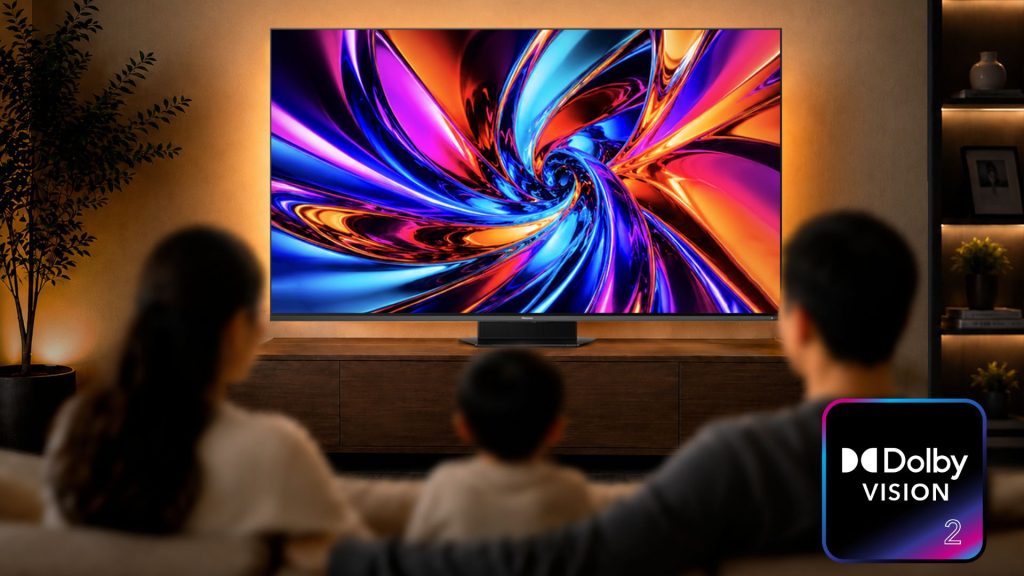
Just the other day, we were wondering what’s going on with Dolby Vision 2. It seems as if Dolby can read our minds across land and ocean as we’ve just received an update on Dolby Vision 2’s progress.
Hisense, who were Dolby’s launch partner when it announced Dolby Vision 2 at IFA 2025, will be bringing the next-gen HDR format to select TVs in the coming weeks, and Dolby claims that once the update has filtered through to the new models, you’ll “immediately notice a difference across all Dolby Vision content”; with the new format helping to create a more authentic and accurate experience.
We’ve seen Dolby Vision 2 in action a few times already this year, and it does look to bring an improvement in picture fidelity across TVs at difference price points. But with this update, this will be the first time that we see the format off the demo stage and in people’s homes.
Which models will receive the update. It’s only available on Hisense’s 2026 models (it’s unlikely that older TVs will receive the update due to Dolby Vision 2 requiring a new chipset for its processing).
Those models are the 2026 UX, UR9, UR8, and U7 (in the UK, Europe and other territories, this will be the U7 Pro). Televisions that run Google TV or VIDAA OS will be first in line to get the update.
There are two different versions of Dolby Vision 2, with a ‘Max’ version that powers premium, higher-performing TV displays, and all the models listed above will be the first in the world to support it.
Dolby Vision II Max comes with features that the ‘standard’ version doesn’t support, with Authentic Motion (which eliminates “unwanted” judder and soap opera effects for newly authored titles), the Light Sense 2 feature that optimises picture quality regardless of whether you’re watching in a brightly lit or dimly lit room; while the introduction of ‘Pro’ settings give users more control over how Dolby Vision content looks and performs on their displays.
But what about the ways you get Dolby Vision II content? Right now only CANAL+, iQIYI (an Asian video-on-demand site) and Peacock gave committed to supporting and producing new content in Dolby Vision II which offers a limited range of programming to view. Similar could be said for its rival, Samsung’s HDR10+ Advanced, though it has signed up Amazon’s Prime Video to support its next-gen HDR format.
We’ll be looking forward to seeing how Dolby Vision 2 performs in the real world, and it hopefully won’t be too long to wait for first impressions to form.
The post Dolby Vision 2 is rolling out on Hisense’s 2026 TVs appeared first on Trusted Reviews.